Thursday, October 18, 2012

The Great Famine

Potatoes were a huge part of Ireland and what its people ate.

The Great Famine, as it is known in Ireland, is what most Americans call the Great Potato Famine in Ireland.
Fact:
  •         About 25% of Ireland’s population was lost because of the famine.
  •        This is said to be part of the reason Gaelic is not very common any more.
  •         Not all the losses of Ireland’s people were caused directly by the famine.

Back in the 1800’s, Ireland began to depend on potatoes quite a bit. There were many poor worker and farmers who needed something cheap and substantial in their diet. Gradually, the potato worked itself in to being the staple food for Irish. Potatoes were especially nice for over the winter. Plus, the poor people in Ireland were much healthier than those in England and such because they ate potatoes. The people in Ireland in general were healthier and lived longer because of the potatoes, but it was the poor who depended on the potato the most. (Wiki)
This is what blight does to potatoes. There is no way to
salvage any of it.
I don’t think most people realize what exactly made these potatoes go bad. They call it the “potato blight”. This is also known as a fungus called phythophtera infestans. It did hit America and other places in Europe, but it didn’t hit anywhere as hard as it hit Ireland. It was supposed to be a really good crop of potatoes in the year the famine started (the first year when people died due to it was 1846). This all changed when the people dug into the ground to find mushy, possibly black potatoes that were not useable at all. This was all due to blight. (History)
Obviously this was not good. The people depended on potatoes so much! After three years of bad crops, they started to worry a bit. Newspapers started to spread about how much the country was suffering, and Ireland started to complain to the Queen. One man in England remarked that Ireland tended to exaggerate things. (Wiki)  Millions of people starving doesn’t need exaggeration!
Basically everyone thought that Ireland had had famines before and that they could take care of themselves, and if they couldn’t then it was their own fault. They figured that it was Ireland’s fault for getting themselves into the mess. (History)
This was a common sight during the famine.
Starving children is not a pretty sight.
People began to starve all over the place. Everyone started to lose their land and any food or money they had left. The famine struck the worst in Western Ireland. People began to die, and those who didn’t, thought it would be a good idea to immigrate to America. They would have immigrated to other places in Europe, but seeing as they had no pity, and that America had more opportunity, they decided America might be better. This is said to be a reason Gaelic didn’t stick around too well. It was mostly spoken in Western Ireland, but so many died or emigrated that it kind of got lost. (History)
All in all, from what we can gather, Ireland lost about 25% of its population to the Great Famine. About half of this percentage was people emigrating. And not all deaths were directly caused by the famine. There were also many diseases that went around at that time. This 25% adds up to an estimated 2 million people!
What can we learn from this story, you might ask? Well, I think that we should learn not to be so dependent on one thing. Especially in the entire country! Imagine if we depended on chocolate and then it just disappeared. That would not be a pretty picture. I think that we can also learn that it is good to help one another out from country to country. If Europe had just helped Ireland out instead of leaving them to die and making matters worse, there wouldn’t have had to be so much death and emigration.


Works Cited
1.      Anonymous, EH.net: Ireland’s Great Famine, 01/10/2010
2.      History Learning Site: The Great Famine of 1845,
3.      Wikipedia Article: Great Famine (Ireland), last updated October 15, 2012.


Tuesday, October 9, 2012

The Salem Witch Trials


The Salem Witch trials are one of the most famous things in American History. Everyone knows about them, but do we really know what happened?

Fact: 

  • 19 people and one dog were killed in this event.
  • One of those people was pressed to death, not hung
  • Witchcraft isn't real.
  • Hundreds more were imprisoned after being accused but weren't hung.
These ridiculous trials supposedly began when a group of teenage girls began going to one of their family's servants named Tituba. Living in the Puritan world wasn't exactly what you would call exciting. The rules were that you live by the Bible, you basically can't have joy, and if you did, you would most likely be punished. These youth were unfortunate enough to have parents among the most strict Puritans. The whole reason they were in America was so they could live the religion more strict. Obviously the girls got bored, so no one can blame them for going and asking Tituba to show them some Indian tricks. 

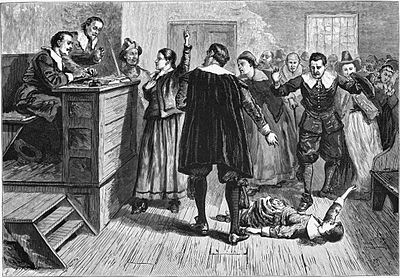
This was fine if no one found out. The problem was, the girls felt really guilty because they knew they had done wrong. Well, the girls ironically started getting "sick". One by one, these girls started having weird "fits" where they were almost possessed. There are several theories as to what these fits are. One theory was that the wheat they grew could have given them a sickness which would make them have seizures and do strange things. Personally, I believe the girls felt so guilty that they made themselves sick.

The girl who got "sick" first, happened to be the daughter of the priest of Salem. The priest called in all the doctors they could, and none could explain the "fits" that the girls were going through. Finally, one doctor made the suggestion of witchcraft. This wasn't a strange suggestion in those times because, as these people came right from England/Europe, Europe had been going through a phase of witch trials. They burned more then a few witches at the stake. There was even a book or two written on witchcraft back then. 

Looking for any explanation to get his family out of this questionable situation, the priest asked his daughter who had done such a thing to her. In hopes that her guilt wouldn't be found out, the girls accused the innocent servant Tituba. And so began the accusations. I think some people might have actually believed in the witchcraft, but I also think that many people were taking advantage of the people's willingness to believe anything. It just so happens that most of the accusations were either made by the poorer people against the wealthier of the town, or the accusations were made by people in families that had quarrels with other families against those other families.

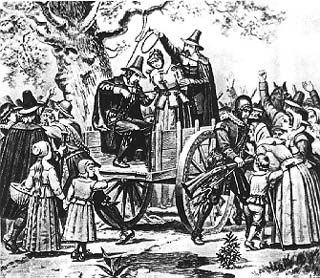
Needless to say, things got a little bit out of hand. Hundreds were accused unfairly and imprisoned. Luckily only 19 people were killed in total. Also unluckily for us a whole 19 people were killed and a dog! The audacity of these people, sheesh. 18 of these people were hung (at least they were nice enough to hang them and not burn them at the stake). The last person that was killed during these trials wasn't even accused of being a witch. It was a nice man in the community who had the courage to stand up to the rest of the community saying the accusations were ridiculous. They got mad at him and decided to press the poor man to death. If you don't know what this is, it is when you lay large stone slabs on to the laying person. You only do so much weight at a time. It took about 48 hours to kill this man.

Luckily for us, these trials did come to an end when someone sensible took charge. If anything is to be learned from this, I think it would be not to repeat it.